George Tatakis · My Greece Atlas
Why black and white?
Not because colour is not beautiful. Because sometimes seeing less allows you to feel more.
ExploreWhy this exists
Not a filter. A way of looking.
Colour can describe a place quickly. Black and white removes the obvious surface and asks the viewer to stay with gesture, light, form, face, cloth and place.
Not a rejection
I do not photograph in black and white because I reject colour. I do it because colour can answer too quickly.
Beyond the surface
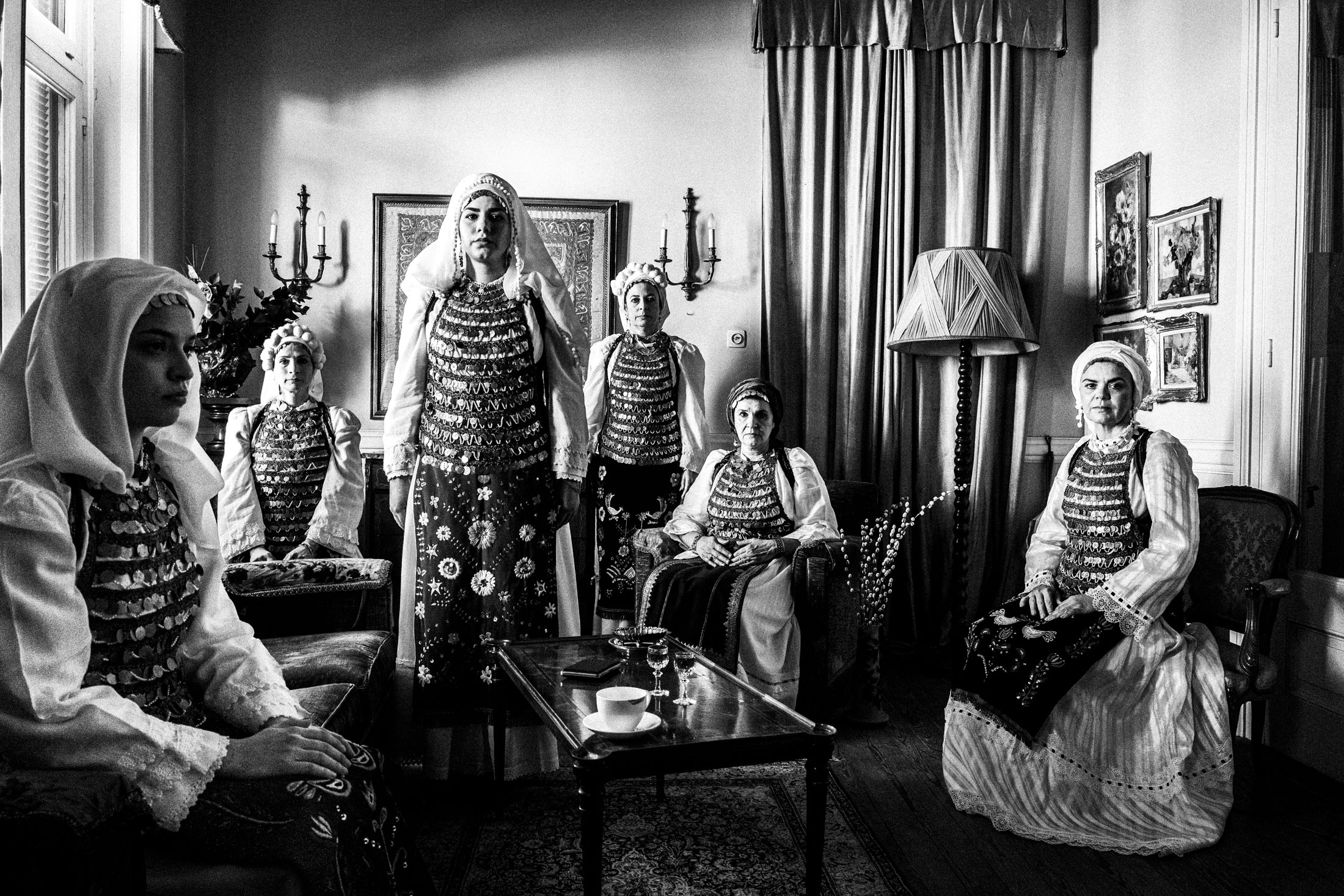
When the bright red, the gold embroidery and the easy beauty are removed, the eye has to look deeper.
The viewer completes it
Monochrome leaves space for memory and imagination. The viewer is no longer just looking; they are participating.
Things monochrome removes
Colour as instruction
No red dress telling the eye where to go.
Decoration as shortcut
No easy postcard beauty before the photograph has begun.
Passive viewing
The mind has to enter, imagine and complete what is missing.
How it works
Monochrome means looked at slowly.
Light
Colour is immediate. It grabs you and tells you where to look. In black and white, the story becomes light, shadow and the way they shape reality.
Essence
Without the easy answers of colour, what remains has to carry the image: form, texture, contrast, emotion and the bones of the moment.
Decision
Black and white is not a shortcut. Every shadow, every highlight and every area of silence has to be intentional.
The image begins in the field.
From colour to attention
It is not nostalgia.
The work is not trying to make Greece look older, simpler or more romantic. It is trying to make the image less immediate and more exact.
In black and white, a costume is not just colour and ornament. A ritual is not just spectacle. A place is not just scenery. The photograph can hold structure, silence, tension and presence.
What remains
What remains when colour leaves.
The photograph becomes less about decoration and more about what carries meaning inside the scene.
- Light
- The way light bends around a face, cuts through a room or turns a procession into structure.
- Shadow
- Depth, silence and the parts of the story that colour often covers.
- Form
- The weight of fabric, bodies, architecture, landscape and gesture inside the frame.
- Memory
- The colours are not gone. The viewer reconstructs them through memory and imagination.
- Meaning
- Less information can make the photograph more open, more demanding and more personal.
A note by
George Tatakis
The black and white language runs through the long-term work on Greek ritual, traditional dress, identity and place.
It is not a nostalgic effect applied afterwards. It is part of how the work is seen, composed and edited from the beginning.